

The phrase bad person is often used to describe someone whose behavior, actions, character, or intentions are considered harmful, dishonest, cruel, selfish, or morally wrong. While the phrase is simple and widely understood, it can feel vague because it does not explain exactly how the person is bad.
People often search for alternatives because different situations require different levels of precision. A teacher writing a report, a journalist describing conduct, a novelist creating a character, or someone having an everyday conversation may all need different words. Some alternatives are formal, some are neutral, and others are highly informal. This guide explains the most useful options, their meanings, tone differences, and when they should—or should not—be used.
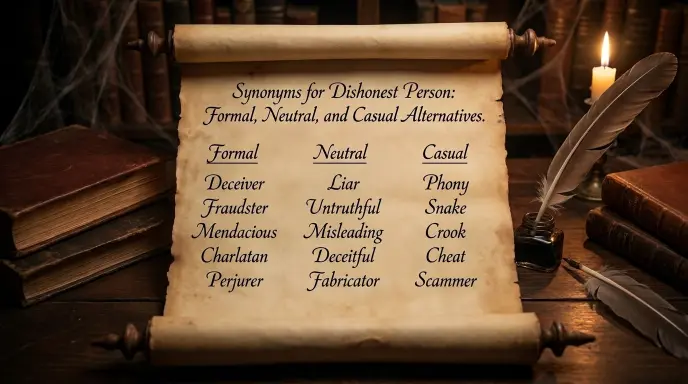
Quick Answer
Some common synonyms and alternatives for bad person include wrongdoer, offender, criminal, villain, scoundrel, rogue, troublemaker, bully, dishonest person, manipulative person, immoral person, and unethical individual. However, these words are not always interchangeable because each carries its own meaning, level of severity, and tone.
Quick List — Fast Reader Section
Closest Alternatives
- Wrongdoer
- Villain
- Scoundrel
- Rogue
- Offender
- Miscreant
- Immoral person
- Unethical person
Formal Alternatives
- Wrongdoer
- Offender
- Perpetrator
- Unethical individual
- Immoral individual
- Malefactor
- Delinquent
- Corrupt individual
- Dishonorable person
- Unscrupulous individual
Neutral Alternatives
- Troublemaker
- Difficult person
- Selfish person
- Dishonest person
- Manipulative person
- Aggressive person
- Toxic individual
- Deceptive person
Casual Alternatives
- Jerk
- Creep
- Bully
- Loser
- Snake
- Mean person
- Bad apple
- Pain in the neck
Contextual Alternatives
- Criminal
- Fraudster
- Abuser
- Cheat
- Liar
- Con artist
- Gangster
- Exploiter
Formal Alternatives
Wrongdoer
Meaning: Someone who commits a wrongful act.
Explanation: One of the closest formal alternatives to bad person. It focuses on actions rather than personality.
Example: The company sought compensation from the wrongdoer.
Best Use: Legal, professional, and formal discussions.
Worst Use: Casual conversations.
Tone: Formal and objective.
Offender
Meaning: A person who breaks a rule or law.
Explanation: Often used in legal and disciplinary contexts.
Example: The offender received a formal warning.
Best Use: Workplace policies and legal writing.
Worst Use: Describing general personality flaws.
Tone: Formal.
Perpetrator
Meaning: Someone who commits a harmful act.
Explanation: Usually refers to serious misconduct or crimes.
Example: Authorities identified the perpetrator.
Best Use: News reports and legal discussions.
Worst Use: Minor disagreements.
Tone: Serious and formal.
Malefactor
Meaning: A person who commits wrongdoing.
Explanation: A traditional formal term often found in literature and legal-style writing.
Example: The malefactor attempted to avoid responsibility.
Best Use: Formal writing and historical contexts.
Worst Use: Everyday speech.
Tone: Highly formal.
Unscrupulous Individual
Meaning: Someone who lacks moral principles.
Explanation: Focuses on ethics rather than criminality.
Example: Unscrupulous individuals often exploit vulnerable people.
Best Use: Professional and academic writing.
Worst Use: Casual conversations.
Tone: Formal and critical.
Corrupt Individual
Meaning: Someone who abuses power for personal gain.
Explanation: More specific than bad person.
Example: The investigation uncovered several corrupt individuals.
Best Use: Politics and business discussions.
Worst Use: General character descriptions.
Tone: Formal.
Dishonorable Person
Meaning: Someone lacking integrity.
Example: His actions were considered dishonorable.
Best Use: Ethical discussions.
Worst Use: Legal descriptions.
Tone: Formal.
Immoral Individual
Meaning: A person who acts against accepted moral standards.
Example: Many viewed the behavior as immoral.
Best Use: Ethics and philosophy.
Worst Use: Casual conversation.
Tone: Formal.
Unethical Individual
Meaning: Someone who violates ethical standards.
Example: The company dismissed an unethical individual.
Best Use: Business and workplace contexts.
Worst Use: Informal discussions.
Tone: Professional.
Delinquent
Meaning: A person who repeatedly misbehaves or breaks rules.
Example: The school addressed the delinquent behavior.
Best Use: Education and youth-related contexts.
Worst Use: Describing all forms of misconduct.
Tone: Formal.
Semi-Formal & Neutral Alternatives
Troublemaker
Meaning: Someone who causes problems.
Example: He gained a reputation as a troublemaker.
Best Use: Schools and workplaces.
Worst Use: Serious criminal situations.
Tone: Neutral.
Dishonest Person
Meaning: Someone who lies or deceives.
Example: A dishonest person cannot earn trust easily.
Tone: Neutral.
Selfish Person
Meaning: Someone who prioritizes personal interests over others.
Example: Her actions seemed selfish.
Tone: Neutral.
Manipulative Person
Meaning: Someone who influences others unfairly.
Example: The manager described the behavior as manipulative.
Tone: Neutral-professional.
Toxic Individual
Meaning: Someone whose behavior negatively affects others.
Example: The team struggled because of one toxic individual.
Tone: Modern and conversational.
Difficult Person
Meaning: Someone who is hard to work with.
Example: He can be a difficult person during negotiations.
Tone: Mild and professional.
Deceptive Person
Meaning: Someone who intentionally misleads others.
Example: The witness described him as deceptive.
Tone: Formal-neutral.
Aggressive Person
Meaning: Someone who behaves in a hostile manner.
Example: Coworkers complained about the aggressive behavior.
Tone: Neutral.
Bully
Meaning: Someone who intimidates others.
Example: The school disciplined the bully.
Tone: Direct.
Cheat
Meaning: A person who gains advantage dishonestly.
Example: Nobody likes working with a cheat.
Tone: Neutral to negative.
Informal / Casual Alternatives
Jerk
Meaning: A rude or inconsiderate person.
Example: He acted like a jerk during the meeting.
When Natural: Everyday conversation.
When to Avoid: Professional communication.
Tone: Informal.
Creep
Meaning: Someone who makes others uncomfortable.
Example: People avoided him because he seemed like a creep.
Tone: Casual and negative.
Snake
Meaning: A disloyal or deceptive person.
Example: He shared private information—a real snake move.
Tone: Informal.
Bad Apple
Meaning: Someone who negatively affects a group.
Example: Every team occasionally has a bad apple.
Tone: Casual.
Loser
Meaning: A highly informal insult.
Example: Stop acting like a loser.
Tone: Casual and harsh.
Mean Person
Meaning: Someone who treats others badly.
Example: She can be a mean person when angry.
Tone: Simple and conversational.
Pain in the Neck
Meaning: Someone who constantly causes annoyance.
Example: He’s a pain in the neck to work with.
Tone: Lighthearted.
True Synonyms vs Contextual Alternatives
| Type | What It Means | Can It Replace “Bad Person”? |
|---|---|---|
| True synonym | Nearly the same meaning | Usually |
| Near synonym | Similar meaning with a different emphasis | Often |
| Contextual alternative | Works only in specific situations | Sometimes |
| Broader expression | Covers more behaviors | Not always |
| Narrower expression | Refers to a specific type of misconduct | Only in certain contexts |
For example, wrongdoer is close to a true synonym, while bully only works when intimidation is involved.
Business Writing
In professional settings, avoid emotionally charged labels.
Preferred alternatives include:
- Unethical individual
- Dishonest employee
- Problematic behavior
- Non-compliant employee
Example: The report identified unethical conduct by several employees.
Corporate Communication
Organizations often focus on actions rather than character.
Better: “The employee engaged in misconduct.”
Less Professional: “The employee is a bad person.”
Academic Writing
Academic writing benefits from precise descriptions.
Examples:
- Immoral individual
- Unethical actor
- Wrongdoer
- Aggressor
Customer Service
Direct character judgments are usually inappropriate.
Instead use:
- Difficult customer
- Disruptive individual
- Abusive customer
Legal Writing
Legal documents rarely use bad person.
More accurate terms include:
- Offender
- Defendant
- Perpetrator
- Fraudster
- Criminal
These terms have specific meanings and should be used carefully.
Email Communication
Professional emails should focus on conduct.
Instead of:
“He is a bad person.”
Use:
“His conduct was inappropriate.”
or
“The behavior violated company policy.”
Email Examples
Subject: Workplace Conduct Concern
Hello HR Team,
I would like to report behavior that appears unethical and inconsistent with company standards. Several employees have raised similar concerns.
Thank you.
Best,
Michael
Subject: Client Interaction Review
Hi Sarah,
The client described the vendor as dishonest after discovering inaccurate information in the proposal.
Regards,
James
Subject: Classroom Incident
Professor,
Several students reported bullying during the group project. I wanted to bring the matter to your attention.
Thank you,
Emma
Subject: Investigation Update
Hello Team,
The review identified a wrongdoer responsible for altering internal records. Corrective actions are underway.
Regards,
Compliance Department
Subject: Vendor Evaluation
Hi Mark,
We have concerns regarding deceptive sales practices and recommend further review before renewal.
Best,
Laura
Short Dialogue Examples
A Person: Why was he fired?
B Person: Management found his behavior unethical.
A Person: What happened at school?
B Person: A bully was harassing other students.
A Person: Can we trust that supplier?
B Person: Some customers described them as dishonest.
A Person: Why are people upset?
B Person: A troublemaker kept disrupting meetings.
A Person: Is the character supposed to be evil?
B Person: Yes, he’s the main villain in the story.
How to Replace “Bad Person” in a Sentence
Original: He is a bad person.
Alternative: He is an unethical individual.
Why it works: More professional.
Original: She is a bad person.
Alternative: She is manipulative.
Why it works: More specific.
Original: The bad person stole money.
Alternative: The offender stole money.
Why it works: Legal context.
Original: He’s a bad person at work.
Alternative: He’s a difficult coworker.
Why it works: Focuses on workplace behavior.
Original: The bad person lied repeatedly.
Alternative: The dishonest individual lied repeatedly.
Why it works: Identifies the exact issue.
Original: That bad person bullied students.
Alternative: That bully targeted students.
Why it works: More precise.
Original: The bad person manipulated people.
Alternative: The manipulative individual influenced people unfairly.
Why it works: Adds clarity.
Original: The bad person committed fraud.
Alternative: The fraudster committed fraud.
Why it works: Uses the specific term.
Comparison Table
| Phrase | Tone | Meaning / Scope | Best Use | Example |
|---|---|---|---|---|
| Wrongdoer | Formal | General wrongdoing | Legal writing | The wrongdoer apologized |
| Offender | Formal | Rule or law violation | Reports | The offender was identified |
| Villain | Literary | Evil character | Storytelling | The villain escaped |
| Bully | Neutral | Intimidates others | School/work | The bully was disciplined |
| Jerk | Casual | Rude behavior | Conversation | Don’t be a jerk |
| Unethical Individual | Professional | Ethics violation | Business | An unethical individual |
| Troublemaker | Neutral | Causes problems | School/work | A known troublemaker |
| Snake | Casual | Disloyal person | Informal speech | He’s a snake |
Which Alternative Should You Choose?
- Formal Writing: Wrongdoer, immoral individual
- Business Communication: Unethical individual
- Academic Writing: Immoral actor, wrongdoer
- Legal Writing: Offender, perpetrator
- Professional Email: Unethical, dishonest, inappropriate
- Everyday Conversation: Troublemaker, bully
- Casual Messages: Jerk, snake, bad apple
Grammar & Usage Guide
- Use articles correctly:
- A bad person
- An unethical person
- Plural forms:
- Bad people
- Wrongdoers
- Offenders
- Avoid unnecessary capitalization:
- Correct: wrongdoer
- Incorrect: Wrongdoer
- Use precise modifiers:
- Dishonest person
- Manipulative individual
- Corrupt official
Common Mistakes to Avoid
- Treating criminal and bad person as identical.
- Using insults in professional writing.
- Confusing immoral and illegal behavior.
- Choosing overly harsh labels without evidence.
- Ignoring context.
- Using vague descriptions.
- Repeating the same term throughout a document.
- Using slang in academic writing.
When Not to Use the Original Phrase
Avoid bad person when:
- You need precision.
- Writing professionally.
- Discussing legal matters.
- Describing specific behaviors.
- Creating academic content.
Use bad person when:
- Writing for younger audiences.
- Keeping language simple.
- Speaking generally rather than specifically.
Advanced Writer Tips
Tone Control
Use wrongdoer for formal writing, troublemaker for neutral contexts, and jerk for casual speech.
Professional Email Etiquette
Describe behavior rather than attacking character.
Politeness
Focusing on actions often sounds fairer and more objective.
Context Alignment
Choose words based on evidence and audience expectations.
Precision
Use specific labels like bully, fraudster, or manipulative person when appropriate.
Readability
Short, familiar alternatives often improve clarity.
Related Questions
What is another way to say bad person?
Common alternatives include wrongdoer, villain, scoundrel, troublemaker, bully, and unethical individual.
What is the most professional alternative?
Unethical individual or wrongdoer usually works best in professional writing.
Is villain a synonym for bad person?
Sometimes, but it often implies a deliberately evil character, especially in stories.
What is the difference between a wrongdoer and a criminal?
A criminal breaks the law. A wrongdoer may act wrongly without committing a crime.
FAQs
What is the closest synonym for bad person?
Wrongdoer is one of the closest formal alternatives.
What is a polite alternative?
Unethical individual or dishonest person can sound more professional.
Is bad person too vague?
Yes. It often lacks detail about the specific behavior involved.
Can I use villain in everyday writing?
Yes, but it may sound dramatic outside storytelling contexts.
What is a legal alternative to bad person?
Terms such as offender or perpetrator are more appropriate.
What is a casual synonym?
Jerk, snake, and bad apple are common informal options.
Should I describe actions instead of character?
In many professional situations, yes. Focusing on behavior is often more accurate and objective.
Conclusion
The phrase bad person communicates a general negative judgment, but it often lacks precision. Depending on your purpose, alternatives such as wrongdoer, offender, unethical individual, troublemaker, bully, or villain may communicate your meaning more clearly. The right choice depends on whether you’re discussing ethics, legality, behavior, personality, or storytelling.
Professional and academic writing usually benefits from specific, objective language. Casual conversations allow more informal options, while legal contexts require carefully defined terminology. By understanding the differences among these alternatives, you can choose words that accurately reflect the situation and match the tone your audience expects.

Emma is a passionate writer who enjoys creating fun, engaging, and reader-friendly content. She has a talent for turning simple ideas into entertaining articles that inform and inspire. With a love for wordplay, humor, and creative storytelling, Emma helps readers discover fresh perspectives and enjoy content that is both useful and enjoyable. When she’s not writing, she enjoys exploring new trends, reading, and finding inspiration in everyday life.